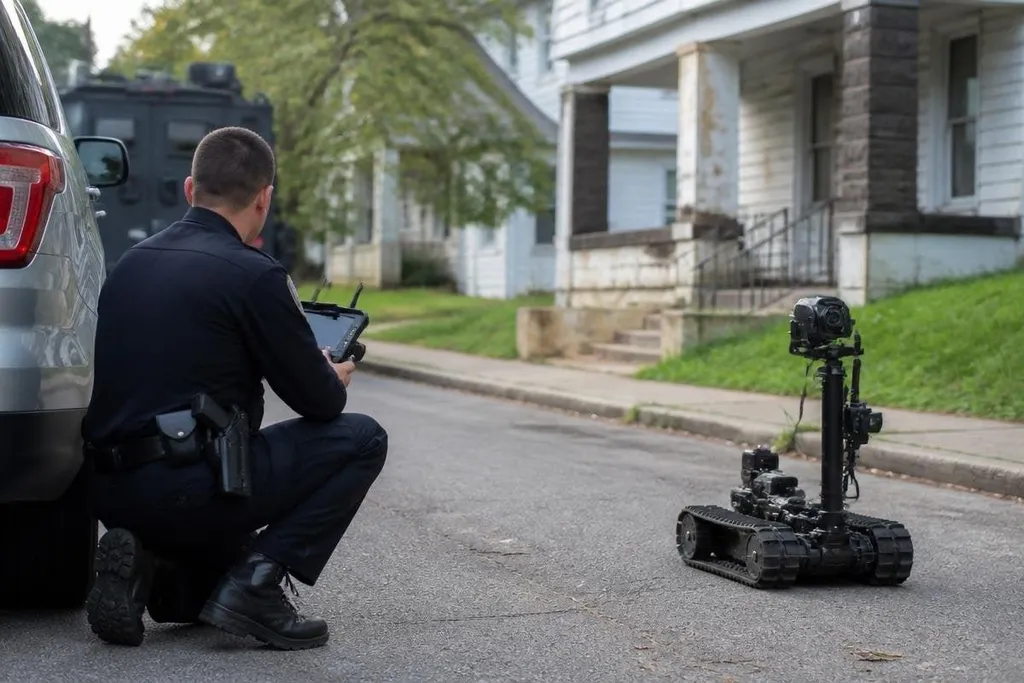
A police robot can place a camera, microphone, speaker, or manipulator near a danger zone while an officer stays farther away. That distance may protect people, but the same machine can raise serious questions about surveillance, force, evidence, and public control.
- Remote video can give officers more information before they enter a scene.
- A speaker lets an officer talk with people from outside a dangerous area.
- Stored robot footage can affect privacy, court cases, and public trust.
What police robots do
Most police robots are controlled by a person through a remote console. The operator may drive a wheeled or tracked base, move a camera, speak through a loudspeaker, or control a small arm that handles an object.
That setup matters because the robot does not replace judgment. It changes where the officer gathers information and where they stand while doing it. A camera can look around a corner, while a microphone can pick up voices that the officer could not hear from a safer position.
Some systems can move through buildings or outdoor areas with limited help from the operator. That does not mean the robot understands the situation. It follows sensor data and control commands, so walls, stairs, poor lighting, a weak wireless link, or a blocked camera can still stop the task.
Where the benefits are real
Distance is the clearest benefit. A robot can inspect a suspected explosive device, enter a room after a report of danger, or check an area where smoke, fire, chemicals, or unstable structures could hurt a person.
The camera and speaker also change the first conversation. An officer may ask someone to show their hands, leave a room, or answer a question without sending a person into the same space. That can give the team more time to assess what is happening.
The robot can also preserve a video record of what its sensors saw. That record may help investigators review an event, but its value depends on the time stamp, storage rules, access logs, and whether the system records continuously or only during a command.
For police use, a robot’s camera record needs a dated account of the machine, command, storage rule, and event before anyone treats it as evidence. Police robotics reporting puts those details beside the public-safety setting, then turns to the risks that begin when the machine enters a live operation.
Where the risks begin
A camera on a robot can collect more than the original call requires. It may record neighbors, children, medical details, house interiors, or conversations that have nothing to do with the incident. Agencies need a clear rule for when recording starts, who can view the files, and when the files are deleted.
Remote control creates another weak point. A lost connection can freeze the robot, delay a warning, or leave it in a place where officers cannot safely reach it. The control station also needs access records, strong login rules, and a way to show which person sent each command.
The machine can change how people react to police. A tracked robot with a camera and loudspeaker may feel less threatening than an armed officer in a doorway, or it may make a situation feel more severe.
That response depends on the design, the words used by the operator, the setting, and the community’s prior experience with police technology.
Weapons create a separate line. A robot that carries a camera or removes an object has a different risk from one that can injure a person. Any policy should name that difference instead of placing every police robot under one broad label.
Rules should come before wider use
A department should publish the robot’s allowed tasks before buying it. The policy should also cover training, recording, maintenance, public complaints, court disclosure, and review after each serious use.
I'd support police robots for inspection and communication when a person faces a clear physical danger, but I'd reject vague rules that let the same system grow into routine monitoring.
A practical department checklist
Use these questions before a pilot or purchase:
- Name the task. Write down the calls the robot may handle and the calls it may not handle.
- Set recording limits. Decide when video and audio start, how long files stay available, and who may copy them.
- Keep a human operator. Record the operator’s identity and each command sent to the robot.
- Test failure modes. Check lost wireless links, low battery, blocked cameras, damaged wheels, and manual recovery.
- Separate weapons policy. Treat inspection, communication, object handling, and force as different uses.
- Review each serious call. Include officers, technical staff, legal staff, and a public complaint process.
A police robot earns a place when it keeps a person out of a defined danger and leaves a clear record of what happened. If an agency cannot explain the task, the recording rules, and the operator’s responsibility in one public document, the purchase should wait.